


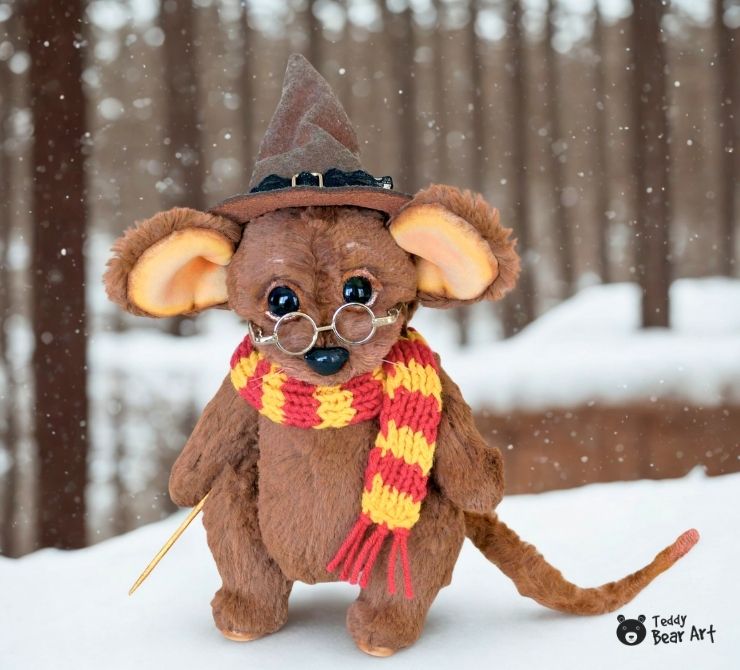
This cute mouse plush pattern brings a classic teddy style project that works beautifully for makers who enjoy traditional materials like viscose, mohair, and soft plush. The pattern focuses on creating a small character with disk joints in the head, arms, and legs, so the finished mouse moves just like a tiny collectible toy.

Download the Pattern
Notice that seam allowances are not included.
To download the pattern, follow the instructions below:
From a phone or tablet: There should be a similar option for mobile devices with Android or iOS. Click on the image. Save it by holding your finger on the image and selecting the “Save Image” option. Then, go to your photo gallery and print it (an option available).
From a computer: Click on the photo of the pattern you see below. In the new tab that will open, you press the right mouse button and select the “Save image as …” option. Then, you choose where the image will be saved on your computer.

Materials and Tools
- Short pile viscose, plush, or mohair fabric
- Strong threads and a needle for hand sewing
- A pair of black glass eyes on a metal loop
- Waxed thread
- Metal pellets or glass pellets for weight
- Fabric for paws
- Discs 22 mm – for the legs – 4 pieces, 18 mm for the arms, and the head – 6 pieces
- T-shaped cotter pins – 5 pieces
- Washers – 10 pieces
- Synthetic filler or sheep wool filler
- Long doll needle
- Scissors
- Pliers
- An awl
- Materials to create the nose (polymer clay, sheep wool, or threads)
- Materials to create the eyelids (felt fabric, sheep wool, or anything you like)
Frequently Asked Questions
Can the mouse be sewn entirely by hand?
Yes, hand stitching works nicely for this pattern. Small backstitches along the curves keep the seams strong and secure. Many artists enjoy sewing tiny teddies by hand because it gives more control over the shaping.
Is viscose easier to sew than mohair?
Viscose has a softer backing and turns smoothly, so beginners often find it comfortable to work with. Mohair is slightly denser, although it holds its shape very well and gives the mouse a refined collectible look.
Can this pattern be resized?
The template can be scaled up or down during printing. A larger version will need bigger joints. A miniature version looks adorable but requires more patience because the pieces become delicate.
Is this pattern suitable for beginners in teddy techniques?
Yes, it is a gentle introduction to disk joints and traditional construction. The small size makes the project manageable, and the simple shapes help new makers practice classic teddy-making steps without feeling overwhelmed.
Before You Go
Make sure to download your cute mouse plush pattern so you can start creating right away. Use mohair, viscose, or plush for a soft, classic teddy feel. Experiment with tiny details like stitched noses, little bows, or outfits to give your mouse personality. Keep the pattern handy for future projects and enjoy adding your own creative touches.
Get Free Patterns & Be the First to Know!
Want free teddy bear patterns, exclusive tutorials, and a chance to win craft supplies?
Sign up for our newsletter using the subscribe form in the middle of this article to receive new patterns, insider tips, and the latest news on teddy bear art. You’ll also automatically be entered into our annual giveaway for a chance to win teddy bear crafting materials.
Bonus entry: Save one of our pins on Pinterest to increase your chances of winning!
Let’s create, inspire, and craft beautiful teddy bears together!
This is such a cute little project! I really like how simple you made the steps, especially the part about resizing the pattern and choosing between viscose or mohair. It’s super helpful for those of us who enjoy sewing but aren’t full-time teddy artists.
The jointed limbs are a nice touch too, gives the mouse that classic collectible feel without being too intimidating. Definitely saving this one for a weekend craft session. Thanks for sharing such a sweet pattern!
Thank you so much! I’m really glad the steps felt easy and helpful. The little joints do add a special charm, don’t they? Hope you enjoy making this mouse on your weekend!
Thank you for this delightful and incredibly generous pattern! I’ve been wanting to try my hand at making a classic, jointed plush toy, and this project is the perfect introduction. This pattern feels like such a thoughtful gift to the crafting community; it provides all the tools and confidence needed to create something special, which is a rare and lovely thing. I can’t wait to start on my mouse this weekend!
Thank you so much for your kind and thoughtful words!
Wishing you a wonderful, creative weekend with your little mouse, and I’d love to see how it turns out. Happy crafting!